

From an Idea to a Viral Video: How AI Is Changing Comedy Content
Written by on September 14, 2026
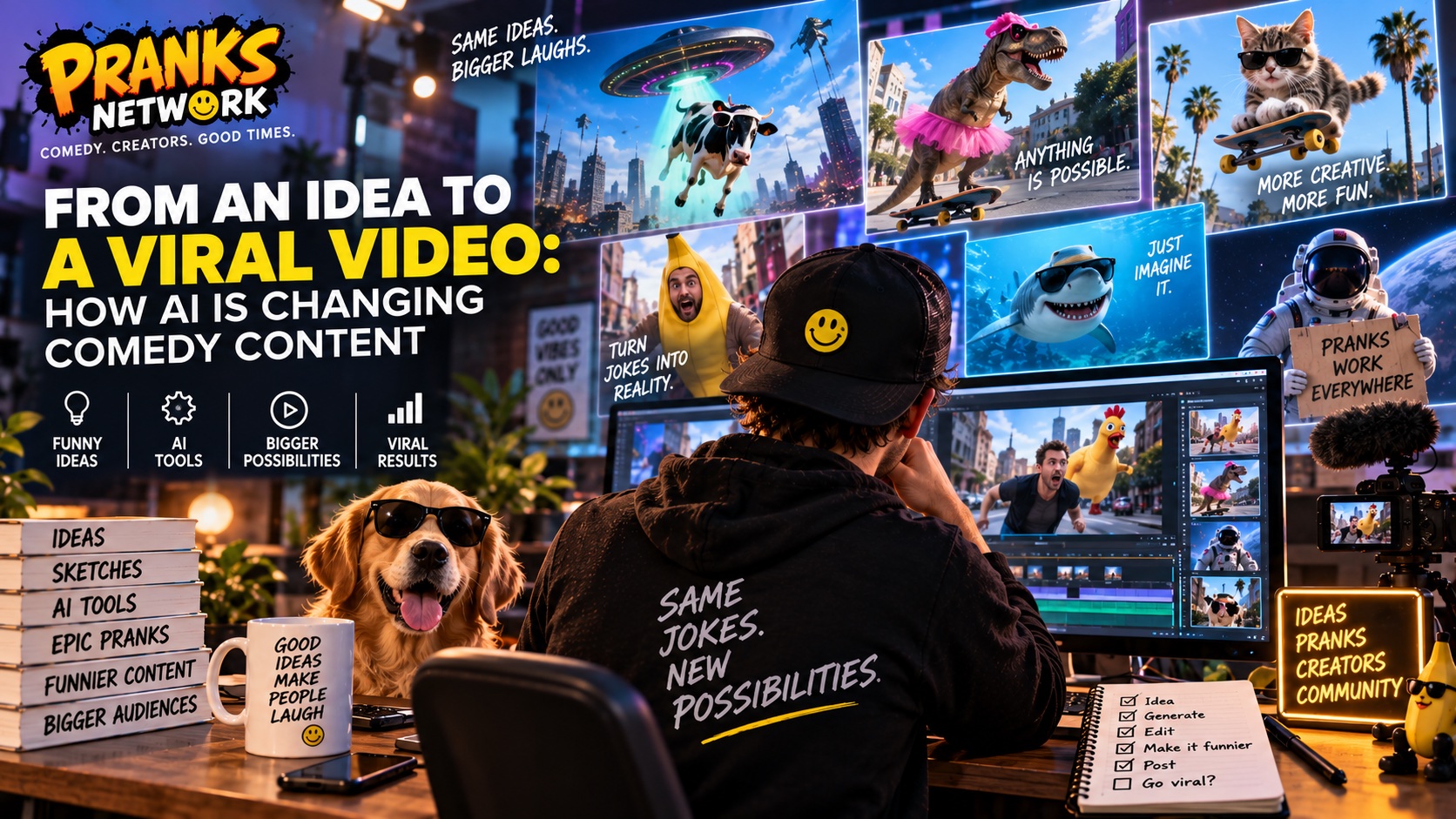
Some of the best comedy starts with a simple question:
What if?
What if an everyday situation suddenly became completely absurd?
What if something happened that could never happen in real life?
What if you took a familiar situation and pushed it so far that the ridiculousness became the joke?
For comedy creators, coming up with those ideas has never been the difficult part.
The difficult part has often been actually creating them.
A funny idea might require an impossible location, an elaborate visual effect, a huge cast, expensive equipment, or a production budget that makes no sense for a short social media video.
Generative AI is beginning to change that.
Creators now have new ways to turn jokes, concepts, characters, and absurd scenarios into visual content without every idea requiring a traditional production.
For comedy, that opens up an enormous creative playground.
Comedy Has Always Been About the Idea
A great camera does not make something funny.
A large production budget does not make something funny.
And sophisticated visual effects definitely do not guarantee that something will make people laugh.
Comedy starts with an idea.
Sometimes it is an observation.
Sometimes it is a character.
Sometimes it is an unexpected reaction.
Sometimes it is simply taking a normal situation and imagining the most ridiculous possible version of it.
The tools used to produce the joke matter, but they are ultimately there to help execute the idea.
That is one reason AI is particularly interesting for comedy creators.
It gives them more ways to execute.
Prank Content Has Already Evolved
Online prank and comedy content has changed dramatically over the years.
Early internet prank videos were often simple.
A camera captured something unexpected happening to another person, and the reaction was the entertainment.
As social platforms evolved, comedy content evolved with them.
Videos became shorter.
Editing became faster.
Visual jokes became more important.
Memes became part of the language of the internet.
Creators developed recurring characters and recognizable formats.
Short-form video created an environment where a joke might need to communicate its entire premise within the first few seconds.
The modern comedy creator is no longer limited to filming a traditional prank.
The canvas has become much larger.
AI Makes the Impossible Part of the Joke
One of the most interesting things about generative AI is that reality no longer has to cooperate with the premise.
Imagine a creator has an idea involving an impossible environment.
Or an animal doing something ridiculous.
Or a normal neighborhood transformed into another world.
Or an ordinary character suddenly placed in a completely unexpected situation.
Traditionally, some of those concepts would require visual-effects artists, elaborate sets, specialized equipment, or significant production resources.
Others simply would not get made.
AI gives creators another option.
Instead of immediately asking, “How could we possibly film this?” the creative process can begin with a different question:
“What would make this funnier?”
How We Use PixyDust in Our Creative Process
At Pranks Network, we use PixyDust as part of our creative process to explore funny ideas, develop visual concepts, experiment with different scenarios, and create digital content around comedy and entertainment.
Sometimes an idea starts with a visual.
Sometimes it starts with a joke.
Sometimes it is simply an absurd scenario that we want to see brought to life.
Having AI-powered video, image, audio, and other creative capabilities available in one place gives us more ways to experiment with those ideas.
We can explore different versions of a concept before deciding which direction works best.
We can see whether an idea that sounds funny actually looks funny.
And we can experiment with concepts that would be difficult to produce using a conventional shoot.
For us, that is the value of the technology.
PixyDust does not come up with our sense of humor.
It gives us another way to turn that humor into something people can watch.
Comedy Benefits From Fast Experimentation
Not every joke works.
Anyone who creates comedy knows that.
An idea can sound hilarious when someone explains it and fall completely flat once it is produced.
Another idea that initially seems ridiculous can become the funniest thing in the room.
That makes experimentation unusually important.
The more easily creators can test an idea, the more ideas they can afford to explore.
AI can reduce some of the cost and time associated with that experimentation.
A creator can try different visual directions.
A scenario can become more exaggerated.
A character can be placed into different environments.
The same premise can be explored several ways.
Instead of treating every creative decision as permanent, the process becomes more iterative.
The First Version Does Not Have to Be the Final Version
That ability to iterate can be particularly valuable in short-form entertainment.
A creator might begin with one visual concept and discover that a completely different version communicates the joke faster.
A realistic scene might be funnier when it becomes intentionally absurd.
A subtle visual might work better when exaggerated.
A concept designed as an image might turn out to work better as video.
AI allows more of those decisions to happen through experimentation rather than speculation.
You can create something, look at it, react to it, and keep developing the idea.
That is much closer to how creativity actually works.
AI Can Expand a Creator’s Comedy Universe
Another possibility is the creation of larger fictional worlds around comedy.
A creator does not necessarily need to make every video as an isolated piece of content.
Characters can return.
Running jokes can develop.
Visual styles can become recognizable.
Absurd fictional environments can become recurring settings.
A joke that works once can inspire an entire series of related ideas.
This has always been possible in entertainment, but traditionally it required resources.
If a fictional world needed sets, animation, costumes, or visual effects, maintaining that world could become expensive.
AI can lower some of those barriers.
That creates the possibility for individual creators and small teams to think more like entertainment studios.
Short-Form Video Rewards Big Ideas
There is an interesting contradiction in modern social media.
Videos have become shorter, but the ideas competing for attention have become bigger.
Audiences scroll through enormous amounts of content.
A creator may have only a few seconds to make someone stop.
That rewards concepts people understand almost immediately.
An unexpected image can do that.
An absurd situation can do that.
A visual that makes someone wonder, “What am I looking at?” can do that.
AI gives comedy creators another way to build those moments.
But getting attention is only the beginning.
The concept still has to deliver.
Technology Cannot Decide What Is Funny
AI can generate an image.
It can help generate video.
It can manipulate audio.
It can help visualize a scenario that never happened.
But none of those capabilities automatically create comedy.
Humor depends on context.
Timing matters.
Personality matters.
Audience expectations matter.
Sometimes the funniest part of a video is a tiny detail that makes no sense outside the culture or community watching it.
Those decisions still require human judgment.
The technology can help create the ingredients.
The creator still has to know what to do with them.
Personality Still Matters
This is especially important for creators who have built audiences around themselves.
People rarely follow a comedy creator simply because that person has access to editing software.
They follow because they like the creator’s personality, perspective, characters, humor, or way of looking at the world.
AI does not eliminate that relationship.
If anything, as more people gain access to similar creative capabilities, personality may become even more important.
The tools become available to everyone.
The point of view does not.
AI Can Also Make Pranks More Creative Without Making Them More Extreme
There is another interesting possibility for prank entertainment.
For years, online prank culture sometimes rewarded escalation.
To surprise audiences, creators could feel pressure to make situations bigger, more disruptive, or more extreme.
But bigger does not necessarily mean funnier.
AI gives creators another direction in which to escalate: imagination.
Instead of making a real-world situation more extreme, the concept itself can become more creative.
The environment can become impossible.
The visual can become absurd.
The premise can go somewhere reality could never go.
That creates another route toward novelty without every idea requiring a larger real-world stunt.
The Line Between Prank, Sketch, Meme, and AI Video Is Blurring
Internet comedy has always borrowed from different formats.
A prank can contain elements of a sketch.
A sketch can become a meme.
A meme can inspire a video.
A reaction can become the beginning of another joke.
Generative AI adds another medium to that mix.
The result may not fit neatly into one traditional category.
Some content will be partly filmed and partly generated.
Some will combine real people with impossible environments.
Some ideas may exist entirely as AI-generated visual comedy.
And new formats will probably emerge that do not yet have names.
That is usually what happens when creators get access to new tools.
More Creative Capability Means More Competition for Attention
There is also a challenge.
If everyone can create more content, everyone will create more content.
The internet is not going to suffer from a shortage of videos.
That means technical quality alone becomes less valuable as a differentiator.
A visually impressive AI video may attract attention today simply because the technology still feels new.
Eventually, audiences will become accustomed to it.
Then the same rules that have always governed entertainment return.
Is the idea good?
Is it surprising?
Is it memorable?
Does it make someone want to send it to a friend?
Most importantly for comedy: is it actually funny?
The Next Generation of Comedy Will Be More Experimental
The history of internet comedy is closely connected to technology.
Cheap digital cameras helped create early viral videos.
YouTube created a global distribution system for independent entertainers.
Smartphones made filming almost constant.
Social platforms changed the length, pace, and structure of comedy.
Now generative AI is giving creators another set of tools.
The most interesting result will probably not be creators using AI to reproduce exactly what they already make.
It will be creators discovering forms of comedy that were difficult to make before.
More strange ideas.
More visual experimentation.
More fictional scenarios.
More unexpected combinations of real footage and generated media.
More opportunities to turn a ridiculous thought into an actual piece of entertainment.
The Joke Still Comes First
Technology changes.
Platforms change.
Formats change.
But comedy has a remarkably simple test.
Did it make someone laugh?
Generative AI can give creators a larger canvas.
It can make certain ideas easier to execute.
It can make experimentation faster.
And it can help visualize things that would have been difficult or impossible to produce before.
But the most valuable part of the process is still the same thing that existed before AI.
A funny idea.
Now creators simply have more ways to bring that idea to life.